Questions & Answers
This page tracks questions raised by community members regarding the proposed EVelution cobalt processing facility and any responses received from project representatives, government agencies, or public officials.
Status Definitions
🟢 Answered – An official response has been provided.
🟡 Partially Answered – Some information has been provided, but additional clarification may still be needed.
🔴 Unanswered – No official response has been identified.
Water Resources
Where will the water come from, and how much will be needed?
Status: 🟡 Partially Answered
Current Information
The proposed facility plans to use groundwater in its cobalt sulfate production process.
Earlier project documents estimated total water demand at approximately 140,000 m³/month, or about 37 million gallons/month. The project’s more recent July 27, 2026 announcement states that approximately 70% of process water is expected to be recycled and reused, resulting in estimated net freshwater consumption of approximately 34 acre-feet/month, or 408 acre-feet/year.
These figures appear to describe different measures: total process-water demand versus net freshwater consumption after recycling.
The project site is located within the Wellton-Mohawk Subbasin of the Lower Gila Aquifer, and groundwater remains the proposed source of make-up water. According to the Yuma Sun (May 31, 2026), WMIDD contributed approximately $95,000 toward drilling and evaluating the project’s test well.
Remaining Questions
- What is the expected actual groundwater withdrawal rate from the production wells during normal operation?
- What is the expected maximum/peak pumping rate?
- How does the approximately 840-gpm requirement identified in the groundwater investigation relate to the 408 acre-feet/year net-freshwater figure?
- Does the 408 acre-feet/year estimate apply only to the initial production capacity?
- If production capacity increases in the future, what would the corresponding groundwater withdrawals be?
- Could higher water-recycling rates be technically and economically feasible?
- What role, if any, will WMIDD have during facility operations?
Groundwater Protection
How will the aquifer be protected?
Status: 🟡 Partially Answered
Current Information
- The Arizona Department of Water Resources (ADWR) Well Registry confirms that the proposed project is located within an area containing numerous registered groundwater wells serving a variety of uses, including irrigation, domestic, livestock, industrial, and other groundwater users.
- The Well Registry identifies registered wells (55-240408, 55-302618, 55-303321) and their reported uses but does not determine whether the project’s wells are hydraulically connected to surrounding groundwater users. Establishing hydraulic connectivity requires hydrogeologic analysis beyond the scope of the Well Registry.
- ADEQ has stated that an Aquifer Protection Permit (APP) is required for any facility with discharges that have the potential to impact an aquifer.
- To date (7-20-2026), ADEQ has confirmed that no APP application has been submitted for the proposed EVelution Energy facility. ADEQ has also confirmed that no Determination of Applicability has been requested to that date.
- Groundwater investigations for the proposed project are ongoing.
Remaining Questions
- What are the results of the groundwater investigation?
- Is the aquifer hydraulically connected to groundwater used by agriculture, municipal users, or other groundwater users in the region?
- Will wastewater be discharged, evaporated, transported off-site, or retained in waste materials?
- How will water-treatment residuals (such as concentrated brine or other treatment by-products) be managed and disposed of?
- What is the anticipated geochemistry of the tailings and other process waste materials that could affect groundwater?
- How will changes in recycled process-water chemistry be monitored and managed over time?
- What groundwater monitoring will be required?
- What spill prevention and containment measures are planned?
- Which groundwater protection permits have been submitted or approved?
Sources see (Timeline + Documents)
- Yuma County Special Use Permit SUP22-08 Special Use Permit
- Extension WMIDD correspondence
- ADWR well records
- Yuma County Board of Supervisors hearing record
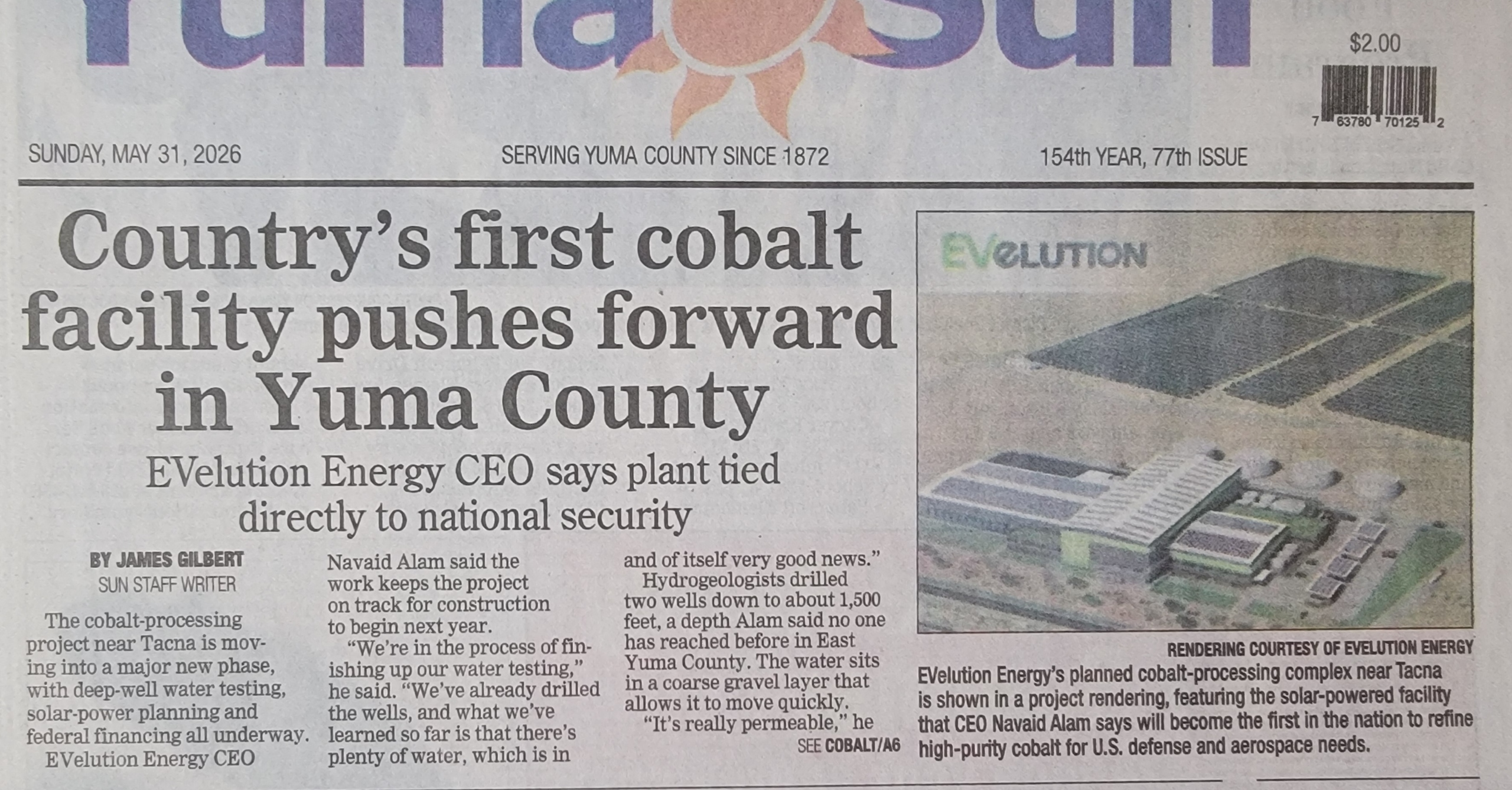
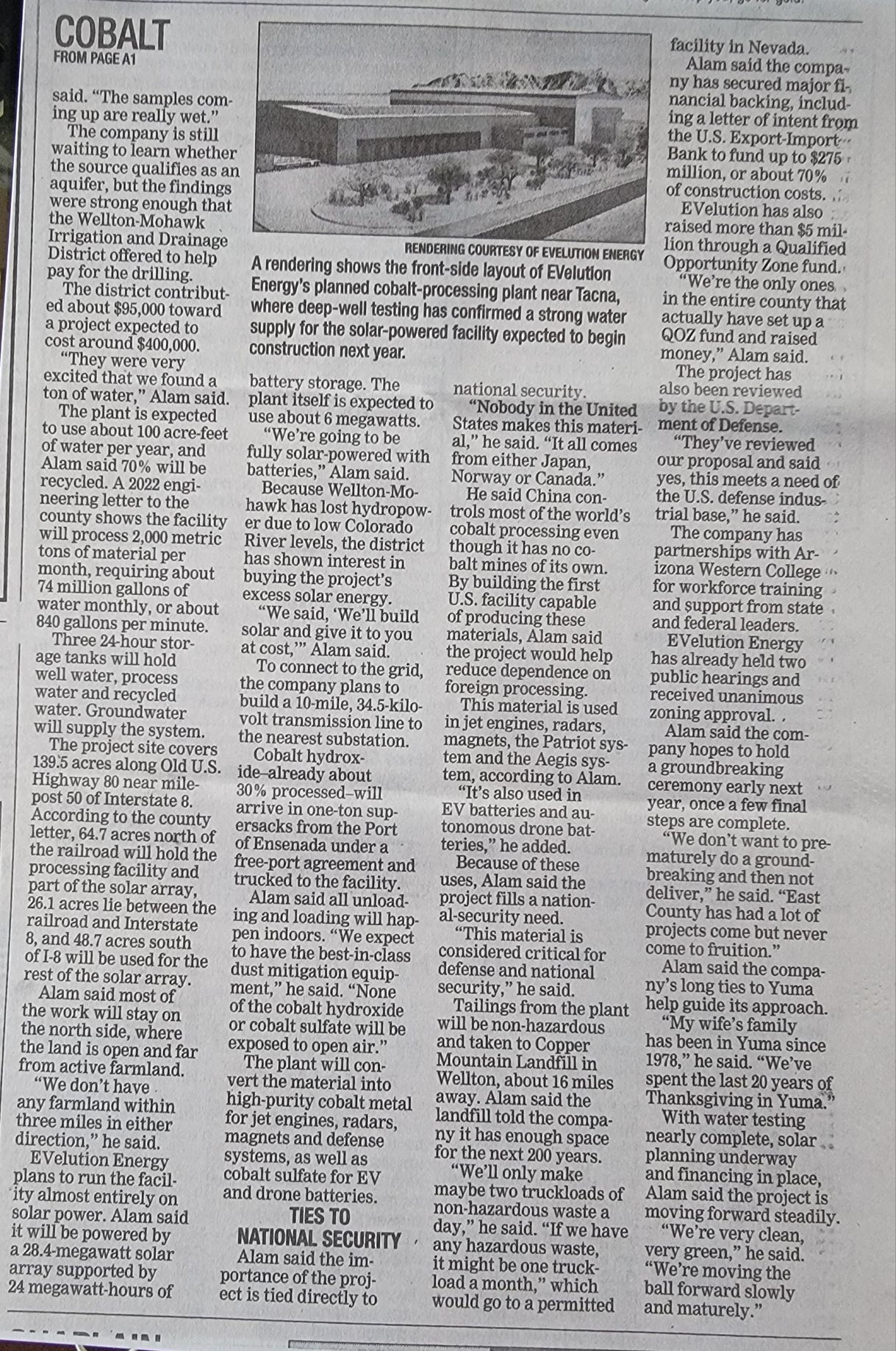
- Yuma Sun, May 31, 2026
Related Document
Aquifer Protection: Understanding the Challenges
Why Treated Wastewater Is Currently Not Considered an Alternative Source
According to information received from the Town of Wellton, treated wastewater is currently used for existing purposes, including golf course irrigation and Colorado River return-flow management.
Waste Management
How will the waste be classified and managed?
Status: 🟡 Partially Answered
Current Information
Company representatives have stated that plant tailings are expected to be classified as non-hazardous. Public statements also indicate that limited quantities of hazardous waste would be generated.
Remaining Questions
- What testing supports the proposed waste classifications?
- What types, quantities, and disposal requirements of waste associated with raw materials, chemical use and processing activities?
- Have the classifications been reviewed or approved by regulatory agencies?
- What management methods are planned for each waste stream?
- What annual waste volumes in total are expected?
Where will the waste be disposed of?
Status: 🟡 Partially Answered
Current Information
Company representatives have stated that non-hazardous tailings would be transported to Copper Mountain Landfill near Wellton. Public statements also indicate that any hazardous waste generated would be transported to a permitted disposal facility in Nevada.
Remaining Questions
- Which disposal facilities have been formally approved?
- What monitoring and environmental protections will apply?
- What public reporting and compliance records will be available?
- Who is responsible for long-term site cleanup and remediation
- How will solar panels and other facility infrastructure be decommissioned and recycled at the end of the project’s life?
- What financial assurance will be available for future cleanup, waste disposal, and site restoration?
Related Document
- Yuma Sun, May 31, 2026 – Country’s First Cobalt Facility Pushes Forward in Yuma County
Community Benefits and Accountability
Financial Support and Public Financing
What public financing and incentive programs support the project?
Status: 🟡 Partially Answered
Current Information
Public reporting references the following public financing:
- Up to $200 million EXIM Bank financing (Letter of Interest)
- Up to $64.8 million EB-5 financing
- Approximately $57.2 million project equity financing
- More than $5 million reportedly raised through a Qualified Opportunity Zone Fund (Yuma Sun, May 31, 2026)
- Approximately $322 million in publicly discussed project financing, plus more than $5 million reportedly raised through a Qualified Opportunity Zone Fund.
Remaining Questions
- What financing has been finalized?
- What public obligations accompany the financing?
- What measurable public benefits are expected in return?
Estimated Annual Revenue and Profit Assumptions
- Approximately $170 million in annual project revenue
Preliminary Analytical Estimates (not official figures).
- Approximately $30–35 million in estimated annual company profit
- Approximately $2–4 million in estimated annual Arizona public return
- Approximately $500,000–1 million in estimated annual Yuma County / Wellton public return
- Approximately $2.5–5 million in estimated combined annual public return
Methodology and Assumptions
Preliminary estimates are based on publicly reported revenue, assumed operating margins, and general tax-revenue assumptions. They are not official company, county, or state fiscal-impact figures.
The purpose of this question is not to determine whether the project has value, but to better understand how long-term public benefits compare to the scale of investment, public support, resource use, risks, and community involvement associated with the project.
Additional discussion is available on the Who Benefits? page.
What long-term benefits will remain in Yuma County?
Status: 🟡 Partially Answered
The proposed facility is expected to receive considerable public support through permitting, infrastructure, public services, groundwater evaluation, public financing mechanisms, and other forms of government involvement.
What measurable long-term benefits will remain in Yuma County and surrounding communities, including permanent jobs, wage levels, tax revenues, community investment, workforce development, and other economic benefits?
Current Information
Publicly available information references:
- Approximately 60 permanent direct jobs
- Approximately 300 indirect jobs (earlier estimates)
- Approximately 1,225 construction jobs
- Approximately $55 million in construction income
- Up to $300 million in construction and development impact
- More recent reports reference approximately 3,300 direct, indirect, and induced jobs and more than $750 million in economic-development impact.
Public sources reference approximately 60 permanent direct jobs at the processing facility.
Additional jobs may be associated with:
- solar operations
- maintenance
- security
- suppliers
- and induced activity
But the number of long-term local positions has not yet been clearly documented.
These figures represent broader economic-impact estimates that include construction activity, supplier spending, and multiplier effects throughout the economy.
They should not be interpreted as permanent employment, direct local government revenue, or direct community benefit.
Remaining Question
- How many of the reported indirect jobs are expected to be permanent local positions in Yuma County after construction is complete?
- Some may be associated with operating and supporting the facility itself,
- while others may reflect broader economic benefits to the surrounding community.
Supply Chain Participation and Value Retention
If public support helps establish domestic processing capacity, how much of the resulting value chain remains in the United States and local communities?
Status: 🟡 Partially Answered
Current Information
Public reporting indicates that EVelution Energy has entered into an approximately $850 million offtake agreement with Mitsui & Co., Ltd., a Japanese multinational trading and investment company, under which Mitsui is expected to receive a substantial portion of the facility’s cobalt production.
Public reporting also references cobalt feedstock supply arrangements involving Entreprise Générale du Cobalt (EGC), a state-owned company in the Democratic Republic of Congo, and Trafigura, a global commodity-trading company headquartered in Singapore with Swiss origins.
As publicly described, the supply chain may involve:
- Cobalt feedstock sourced from the Democratic Republic of Congo
- International commodity-trading and supply-chain participation
- Processing in Arizona
- Offtake arrangements with Mitsui and other downstream customers
Public reporting describes these arrangements as part of efforts to strengthen domestic and allied critical-mineral supply chains.
Remaining Questions
- What portion of the downstream manufacturing value chain will occur within the United States?
- What portion of the economic value created from processed cobalt will remain in Arizona and Yuma County?
- How much of the downstream manufacturing process will occur within allied international supply chains?
- How much value is retained by suppliers, commodity traders, processors, manufacturers, and end users at each stage of the supply chain?
- How do these supply-chain arrangements relate to the project’s public-benefit objectives and long-term economic impact?
Related Documents
- Reuters: EGC, EVelution Energy, and Trafigura agree to develop a U.S.-DRC cobalt supply chain
- EVelution Energy Announces $850 Million Mitsui Offtake Agreement
- Opportunity Zones Interview with EVelution Energy discussing project financing and supply-chain strategy
What long-term accountability mechanisms will exist?
Status: 🔴 Unanswered
Remaining Questions
How will project commitments be tracked, measured, and reported over time?
- What accountability mechanisms will remain in place after project approval and construction,
- who will be responsible for addressing future
- environmental,
- infrastructure,
- water-resource,
- waste-management,
- or community impacts associated with the project?
Emergency Preparedness
What emergency response plans are in place?
Status: 🟡 Partially Answered
Current Information
Public statements indicate that the company has discussed workforce-development and training partnerships with Arizona Western College. However, no detailed emergency-response plans, hazardous-material response plans, evacuation procedures, or agency coordination plans have yet been identified in publicly available documents.
Remaining Questions
- What emergency-response capabilities, accident-planning procedures, and hazardous-material response plans have been identified for the project?
- Which local, county, state, and federal agencies would have primary responsibility for responding to a chemical incident?
- Which fire department and HazMat team would be the first responders, and what is the expected emergency response time to the facility?
- What specialized training, equipment, and resources would be available for hazardous-material incidents?
- What coordination, communication, and preparedness activities are planned among responding agencies?
- What emergency planning information will be available to nearby communities?
- Will the facility maintain its own on-site emergency response capabilities, or will it rely entirely on public emergency services?
Workforce Training and Public Support
Status: 🟡 Partially Answered
Current Information
Public reporting references workforce-training discussions between EVelution Energy and Arizona Western College.
Remaining Questions
- Who will fund workforce-training programs associated with the project?
- Will training be funded by the company, public institutions, state programs, federal grants, or a combination of sources?
- What public costs, if any, are associated with workforce development for the facility?
- Will training opportunities be available to local residents?
Funding source currently unknown.
If the public is helping provide infrastructure, financing workforce development, or other support, what public benefits are expected in return?
Related Documents
- Yuma Sun, May 31, 2026 – Country’s First Cobalt Facility Pushes Forward in Yuma County
- Arizona Western College workforce-training discussions
Transportation
Transportation and Supply Chain Logistics
Question: How will raw materials, finished products, and waste be transported?
Status: 🟡 Partially Answered
Current Information
Public statements indicate that cobalt feedstock is expected to be sourced through international supply chains, including material originating from the Democratic Republic of Congo.
- Raw cobalt hydroxide is expected to arrive through the Port of Manzanillo, Mexico.
- The material is expected to be transported by rail to the Wellton processing facility.
- The final transportation route and logistics have not yet been publicly documented.
Remaining Questions
- What final rail route and border crossing will be used to reach the facility?
- How many rail shipments are expected per month?
- Will trucks be used for any part of the inbound transport?
- What impacts have been evaluated for local rail crossings, roads, and highways?
- Which agencies have reviewed the transportation and logistics plans?
Related Documents
- Yuma Sun – Transportation and Logistics Overview
- Reuters – U.S.-DRC Cobalt Supply Chain MOU
- EVelution – $850 Million Mitsui Offtake Agreement
What transportation impacts will result from waste disposal?
Status: 🟡 Partially Answered
The Yuma Sun May 31, 2026 article states:
- Approximately two truckloads per day of non-hazardous waste.
- Hazardous waste may be approximately one truckload per month.
Remaining Questions
- What transportation impacts may result from waste disposal?
- Which agencies will be responsible for oversight of waste transportation and routing?
- What transportation routes will be used?
- What emergency-response planning considerations have been identified for waste transportation?
- How many truck shipments associated with raw materials, chemical supplies, finished products, waste disposal, employee traffic, and construction activity are expected?
- How will traffic affect nearby communities, schools, agricultural operations, and emergency-response access?
Public reporting confirms that waste transportation will occur, but overall transportation volumes associated with raw materials, chemical supplies, finished product shipments, employee traffic, and construction activity remain unclear.
Related Documents:
- Yuma Sun, May 31, 2026 – Country’s First Cobalt Facility Pushes Forward in Yuma County
Power and Infrastructure
What power infrastructure and backup power arrangements will support the facility?
Status: 🟡 Partially Answered
Current Information
- Public reporting references an approximately 28.4 MW solar facility associated with the project.
- Company representatives have stated that the facility is intended to operate primarily on solar power and that surplus power may be available for agricultural users.
Remaining Questions
- Will any transmission or infrastructure upgrades be required?
- What is the facility’s anticipated peak power demand?
- How much power will be supplied directly by the solar facility?
- What backup power sources will be used when solar generation is insufficient?
- Will backup power rely on the electrical grid, generators, battery storage, or a combination of sources?
- How much energy storage (battery capacity) is planned?
Wildlife and Environmental Impacts
What environmental studies have been completed?
Status: 🔴 Unanswered
Remaining Questions
- What studies have been conducted regarding wildlife habitat?
- Migratory birds?
- Protected species?
- Habitat fragmentation?
- Other environmental impacts associated with the project?
Air Quality Impacts
What air emissions are expected from the facility?
Status: 🔴 Unanswered
Remaining Questions
- What air emissions are expected during normal operations?
- Will any sulfur-containing compounds be used, produced, or emitted during processing?
- Are any odor impacts anticipated?
- What air-quality monitoring and emission-control systems are planned?
- What regulatory permits and reporting requirements will apply?
Department of Defense Involvement
What role does the Department of Defense play in the project?
Status: 🟡 Partially Answered
Current Information
Public reporting has highlighted the strategic importance of domestic cobalt processing for critical-mineral supply chains and the U.S. defense industrial base.
According to public statements, the project has been reviewed by the Department of Defense and has been described as supporting domestic supply-chain resilience for strategic materials.
Remaining Questions
- What specific role does the Department of Defense play in the project?
- Has any defense-related funding, grant support, financing support, contract support, or other assistance been provided?
- What public benefits are expected from that involvement?
- How does Department of Defense involvement relate to the project’s long-term objectives and accountability?
Sources
- Yuma Sun, May 31, 2026
- Public statements by EVelution Energy regarding support for the U.S. defense industrial base, as reported by the Yuma Sun, May 31, 2026.
Publicly reported figures and preliminary analytical estimates are presented for informational purposes and should not be interpreted as final audited fiscal-impact data.
Sources & References
News Reports:
• AZBEX (March 29, 2023)
“Yuma County to Get Cobalt Processing Plant”
https://azbex.com/planning-development/yuma-county-to-get-cobalt-processing-plant/
See Yuma Sun Article (May 31, 2026)
Article discussing water use, economic impacts, workforce development, and Department of Defense review.
• KYMA (May 19, 2026)
“Cobalt facility planned for Yuma County moves forward”
https://kyma.com/news/top-stories/2026/05/19/cobalt-facility-planned-for-yuma-county-moves-forward/
Trafigura / EGC supply chain
Reuters – EGC, EVelution Energy and Trafigura agree to develop U.S.-DRC cobalt supply chain
Mitsui offtake agreement
EVelution Energy Secures $850 Million Cobalt Offtake Agreement with Mitsui
Opportunity Zones interview
Opportunity Zones Interview with Navaid Alam
Government and Public Records
• Arizona Department of Water Resources (ADWR)
https://www.azwater.gov
• ADWR Well Registry
https://app.azwater.gov
• Arizona Department of Environmental Quality (ADEQ)
https://www.azdeq.gov
• Yuma County Board of Supervisors Meeting – June 1, 2026
https://play.champds.com/yumacoaz/event/611/s/58
Correspondence
• WMIDD correspondence, June 2026
• ADEQ correspondence, June 2026
• Communications with project representatives and consultants, June 2026
 yumaindustrialbenefit.org