The Future of the South West
Arizona is building a civilization that depends every year significantly more on electricity and water.


Arizona itself is already acknowledging how extraordinary the change is:
- APS says its system took nearly 140 years to reach an 8,000-MW peak
- but it now expects peak demand to exceed 13,000 MW within about 14 years, roughly a 60% increase
- driven largely by chip manufacturing and data centers
- The Arizona Corporation Commission reports the state currently has roughly 2 GW of operating data-center capacity
- with more than 10.6 GW more planned
APS and SRP have told regulators that requests from prospective large-load customers already exceed their capacity to serve them.
The question is not whether Arizona can keep its data centers running. It is whether the infrastructure being built today can keep supporting 7.6 million people — and the agriculture, water, food, cooling, healthcare, and transportation systems they depend on — through a prolonged disruption.

What depends on it:
- 7.6 million+ people → drinking water, food, cooling, sanitation, basic survival
- Agriculture → irrigation water + pumping/delivery energy
- Critical-mineral production → enormous water demand + electricity
- AI data centers → enormous electricity + cooling-water demand
- Semiconductor manufacturing → water + electricity
- Water pumping, treatment, and distribution → electricity
- Hospitals and emergency services → electricity + water
The weakness in the existing rules: Arizona is rapidly adding new demands to both its electrical grid and its water supply, but the rules don’t evaluate either system as fast as Arizona is changing.
| Observation | Electricity | Groundwater |
|---|---|---|
| The gap | Major GMD vulnerability assessments can be 5 years apart. AI-era change: measured in months. | Outside Arizona’s regulated groundwater areas, large withdrawals can occur without any comprehensive assessment of cumulative impact on the aquifer. |
| The risk | New loads can be added between assessments with no way to know if resilience has kept pace. | Individually legal pumping can collectively lower groundwater levels — affecting farms, communities, ecosystems, and future supply. |
| A better approach | Reassess resilience when major new loads materially change the grid and the risk. | Colorado’s principle: evaluate whether water is actually available and whether new pumping will harm future supply, existing users, using hydrological and geological evidence. |
Compliance of the individual parts does not mean resilience of the whole system.
And in Arizona, the two systems are locked together: water needs electricity, and electricity-dependent growth needs water.
Inside Active Management Areas, substantial groundwater protections exist. Outside AMAs and Irrigation Non-Expansion Areas, groundwater is governed only by “reasonable and beneficial use,” and ADWR itself says it generally has no statutory authority to regulate the impact of one landowner’s pumping on a neighbor.
That framework’s roots reach back more than a century, built for an Arizona that no longer exists.
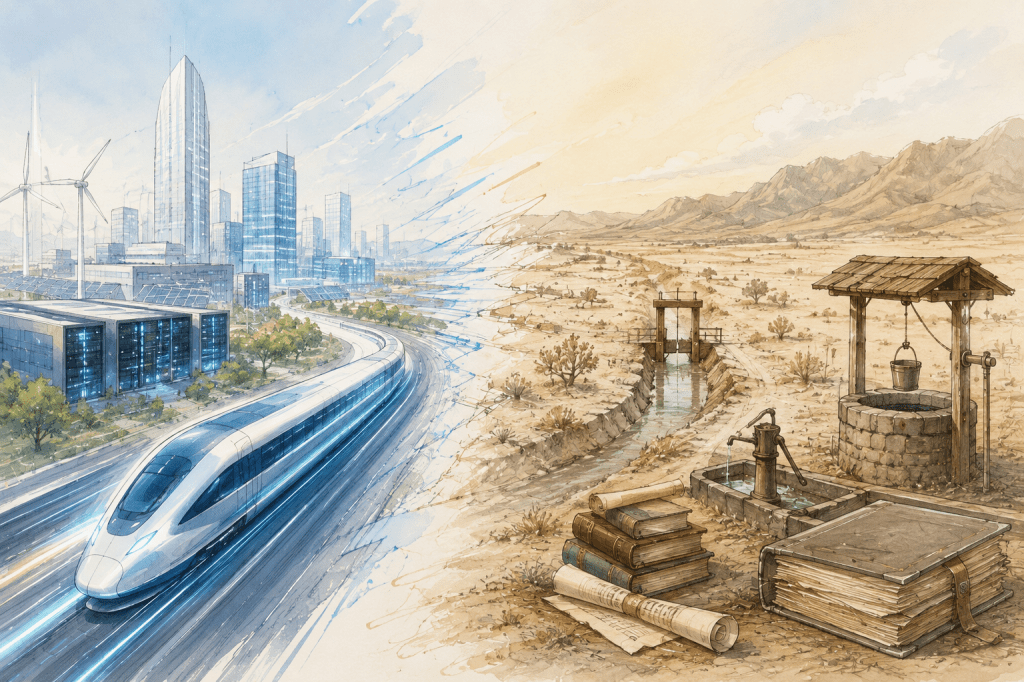
At the same time, it is becoming considerably more vulnerable to system overload, extreme weather, geomagnetic disturbance, cyberattack, and supply failure.
If the electrical grid suffers a prolonged failure, water pumping, communications, refrigeration, healthcare, and fuel distribution can fail with it.
If groundwater levels keep declining without anyone tracking the cumulative effect, the problem isn’t only how much water is left — declining water tables can also mobilize naturally occurring contaminants like arsenic; meanwhile,
Arizona’s other major water source, the Colorado River system including Lake Mead, is under significant long-term pressure.
This stops being regulatory questions and becomes questions of basic resilience, and at the extreme, survival.
That doesn’t mean predicting catastrophe.
It means recognizing something simpler:
Arizona is entering a new era at extraordinary speed, while many of our laws, planning cycles, and response habits were built for a world that changed much more slowly.
The challenge is to make our systems evolve as fast as the reality around them.
Arizona Water Law: Built for a Different Arizona
The groundwater rule itself isn’t literally an 1864 law. Arizona’s 1864 Howell Code dealt with surface water and said essentially nothing about groundwater.
The University of Arizona’s Water Resources Research Center describes it as a framework from a time when groundwater wasn’t yet viewed as a major resource. Groundwater law developed separately: Howard v. Perrin (1904) began Arizona’s early groundwater doctrine; Bristor v. Cheatham (1953) and the 1980 Groundwater Management Act substantially built it out.
Early thinking treated groundwater somewhat like a mineral deposit beneath the land, not the interconnected resource we now understand it to be.
Current Situation of the Electrical Grid
NERC’s standard, TPL-007-4, requires utilities to perform GMD vulnerability assessments at least once every 60 months — five years.
That cadence was built for a power system that historically changed slowly. Put it beside Arizona today: ~2 GW of data centers operating, another ~10.6 GW planned, APS projecting a ~60% peak-load increase, plus new semiconductor fabs, AI demand, and electrification. Those are two very different time scales, TPL-007 also only applies to large grounded transformers above 200 kV.
It isn’t a standard guaranteeing Arizona’s whole electrified civilization keeps functioning after an extreme cyberattack or Carrington-class solar storm.
What matters isn’t only how much new generation Arizona adds –
but what shape it takes, and the same principle holds for water.
- A pumping permit that’s individually compliant can still add to a pattern of concentrated, cumulative withdrawal that no single review ever evaluates.
- Distributed solar, batteries, and microgrids that can island themselves make the grid more resilient.
- Concentrated generation tied through more long, high-voltage transmission corridors creates more of exactly the infrastructure —
- long conductors and large grounded transformers — that’s vulnerable to geomagnetic disturbance.
- The same logic applies underground: scattered, monitored withdrawals evaluated against real aquifer capacity behave very differently
- than concentrated industrial-scale pumping approved one project at a time, with no one ever measuring the cumulative draw.
Large data centers and fabs could even become part of the solution, with batteries and local generation letting them disconnect and run independently during a disruption.
But that requires deliberate design, not default buildout…
Is Arizona’s grid-resilience planning evolving as fast as its expansion of electricity-dependent industry? The evidence suggests, not yet.
Regulators are actively working the capacity problem — the ACC held a dedicated large-load workshop in April 2026 — while WECC separately identifies geomagnetic disturbance as a real Western-grid risk. There’s no clear sign yet that Arizona has connected the two: reassessing GMD resilience specifically for the grid being built for 2030–2040, as opposed to the grid that exists today.
Existing federal rules — NERC’s EOP-010 and TPL-007, and an IEEE standard on transformer resilience to geomagnetically induced currents — mean the grid isn’t oblivious to the threat. They don’t mean a severe event couldn’t still cause serious damage.
The real Arizona question is whether water systems, hospitals, and fuel distribution could keep functioning if the Western grid were down for days or weeks…
And how long recovery would take if critical, specialized equipment were damaged and supply chains were disrupted at the same time. In a severe scenario, recovery could take months or years, at enormous cost.
(In April 2025, a single cascading failure knocked out power across all of Spain and Portugal — roughly 50 million people — for most of a day, with some areas taking even longer to recover).
At that point, this stops being an emergency-preparedness question. It becomes a question of:
How long a modern desert society can function without the interconnected systems that provide water, cooling, healthcare, and food —
a harder and more consequential question than whether Arizona has a plan on paper.

Change is not the danger.
The danger is failing to adapt when the world around us has already changed.
Realizing, that we can belong to a future even though we have never lived in it.
— Maria Coffee
Resources:
Arizona Electricity & Data Centers
https://www.aps.com/en/About/Our-Company/Newsroom/Articles/Powering_Arizonas_Remarkable_Growth
https://www.azcc.gov/news/home/2026/04/20/acc-large-load-data-center-workshop-highlights
Groundwater Law
https://www.azwater.gov/groundwater-pumping-outside-amas-and-inas
https://www.azwater.gov/ama/active-management-area-overview
https://www.azwater.gov/1980
Colorado River & Lake Mead
https://www.azwater.gov/lake-mead
https://www.azwater.gov/drought
Colorado Comparison
https://law.justia.com/codes/colorado/title-37/water-rights-and-irrigation/underground-water/article-90/section-37-90-137/
 yumaindustrialbenefit.org